
Past Exhibitions - 2017
Exposure 2017
3 - 10 November 2017
Image: Elisabeth Pointon

Breathing in Glass, Running Out of Air
Rosanna Raymond
11 - 20 October 2017
To coincide with the 2017 Massey University Peter Turner Memorial Lecture, The Engine Room is proud to present Breathing in glass, running out of air a special exhibition event featuring new work from Rosanna Raymond.
Consisting of photographic and text-based works, Breathing in glass, running out of air posits multiple registers of Raymond’s practice through performative action, photographic image and poetry. Two photographic images peka and Say my name(both 2017) are presented in collaboration with photographer Kerry Brown. Alongside these two of Raymond’s poems are presented as large-scale ‘banners’ and exhibited for the first time.
Rosanna Raymond is an artist, curator, researcher and founder of the SaVAge K’lub. She is also a long-standing member of the Pacific Sisters, an art collective that was formed in the early 1990s to evolve a Pacific voice for Aotearoa New Zealand art through a repertoire of avante garde art performances and large scale fashion events. In 2016 Rosanna curated Ata Te Tangata, a survey exhibition of photographers of Māori and Pasifika heritage for the Pingyao International Photography Festival, and in 2017 she was awarded a Chester Dale Fellowship to undertake research in the collections of the Metropolitan Museum in New York.
List of artworks available HERE
Common Good
Curated by Karin van Roosmalen
13 - 22 September 2017
Susanna Bauer, Ipek Çankaya, Kate Linzey, Raewyn Martyn, Karin van Roosmalen, Stuart Shepherd, and Jasmine Te Hira
Raewyn Martyn presents ‘biofacts and biofictions that arguably refuse to become artifacts. They are made using methyl-cellulose powder and calcite, [aka bird shit] (that possibly includes some live coccolithophores at the time of collecting it, for the sake of biofiction we can say it does).’ Martyn visits her own history, specifically her father’s experiences of working for the Ministry of Education under the Key government, and his consequent photographic fixation with birds and mushrooms as models of circulation and distribution.
Ipek Çankaya writes out of the Institute of Social Sciences, Department of Media Studies, Yeditepe University, Istanbul, where she is a PhD candidate. Her publication for Common Good discusses the challenges to the management and sustainability of art initiatives in a climate of neoliberal cultural policy in Turkey.
Karin van Roosmalen’s assembled items explore the relationship between political content and the formal artwork. The installation investigates hierarchy and isolationism, and recognition and respect, or the lack thereof, within the tertiary education environment, as it is experienced on a day-to-day basis. Precarity, as a defining form of ontology in our global context, is addressed through a wandering form of attention, the missing of the point, an aversion to the centralized.
The no-budget, homemade ethos of Stuart Shepherd’s video has been inspired partly by silent movies. ‘A feature of the production is the collaboration with people from the local Handicapped Development Center Davenport, Iowa —and the support provided by Rozztox, Rock Island Illinois, the performance bar where I’m currently staying — the video would really be more at home playing in a store window, or on the wall in an empty bar ... it’s aligned with low art….’
In Cloak and Dagger (Unter den Talare), Susanna Bauer draws on the symbols and rituals which the university celebrates as its forms of self- presentation. These call upon a lineage of an independent scholarly tradition connected across centuries. All the while the institution seeks to evoke an educational community of scholarship and learning, it has in fact implemented the neoliberal transformations that in recent decades have been eroding it from within. In their attempts to critique the system academics find themselves in a double bind – both as products of the system and implicated as collaborators, they encounter their own spectre beneath the shroud.
Jasmine Te Hira is an artist currently working in the museum and gallery sector in Tāmaki Makaurau. Te Hira's practice considers the way in which taonga trace skin, often embodying indigenous knowledges while traversing institutional critique and spaces. In 2016, Te Hira received a Creative New Zealand Pasifika Internship continuing to work as the Kaiāwhina ki Te Uri for Gottfried Lindauer: The Māori Portraits 2017 exhibition at Auckland Art Gallery Toi o Tāmaki. Te Hira's current work at Tautai Contemporary Pacific Arts Trust sees her establishing a community research archive. Her work is exhibited nationally and internationally with The Beauty of Invisible Grief being the joint major winner of the 2016 Molly Morpeth Canaday 3D Awards.
Kate Linzey has had a lifelong relationship with tertiary education including over 10 years of being a student and 15 years as teaching staff. She currently lives in Wellington, studies in Queensland and dreams of finishing her thesis.
Rough Rough
Soraya Rhofir (France)
1 - 25 August 2017
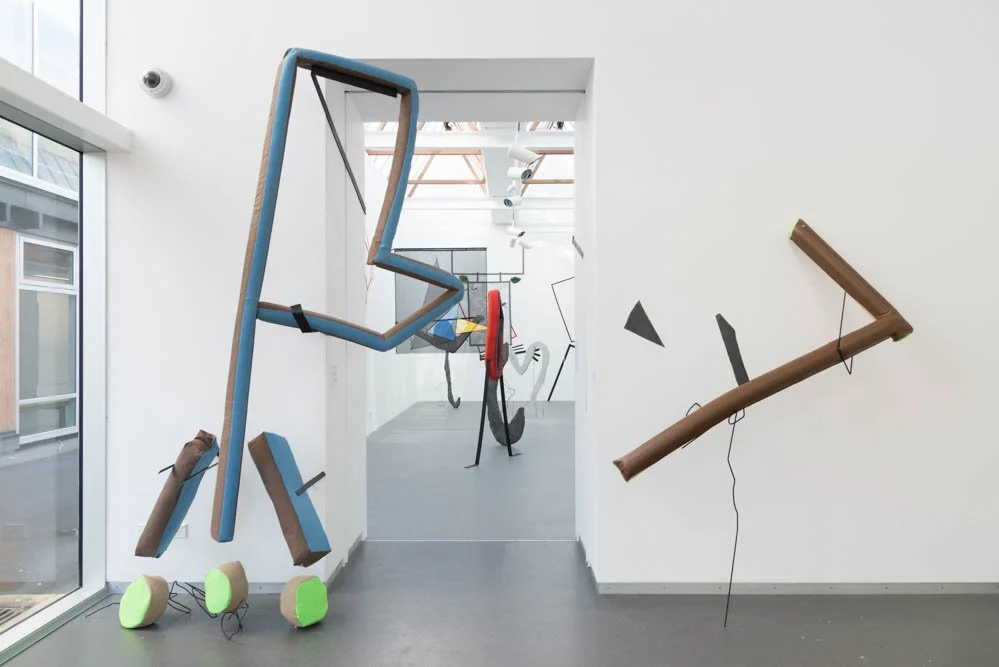
Rough Rough, an exhibition of new works by Soraya Rhofir.Rhofir borrows from Aotearoa/New Zealand’s everyday culture to produce work that she describes as “…an ensemble, a palette constructed as a collage, each piece opens to a dimension of ‘rough’: its vulnerability, its flexibility, its lightness…the pieces are nomadic, openings to another event, a horizon made of fabric, foam and wire”. Rhofir has historically worked with collage, clip art, big shifts in scale and immersive installations, but in this new body of work she expands her repertoire to include 3D inflatable objects, carved foam sculptures and printed textile banners. The various components are suspended from the walls and ceilings and meet us at ground level.
In association with Te Whare Hēra International Artists’ Residency and with grateful support from the French Embassy of New Zealand.
Soraya Rhofir has exhibited at Les Eglises in the city of Chelles (2013) and at Parc Saint-Léger, in Pougues-les-Eaux (2012). She was short-listed for the 2010 Prix Ricard art prize for artists under 40 in Paris, and for the international short list at Present-Future Artissima Turin International Art Fair in 2014.
These Things that are Different
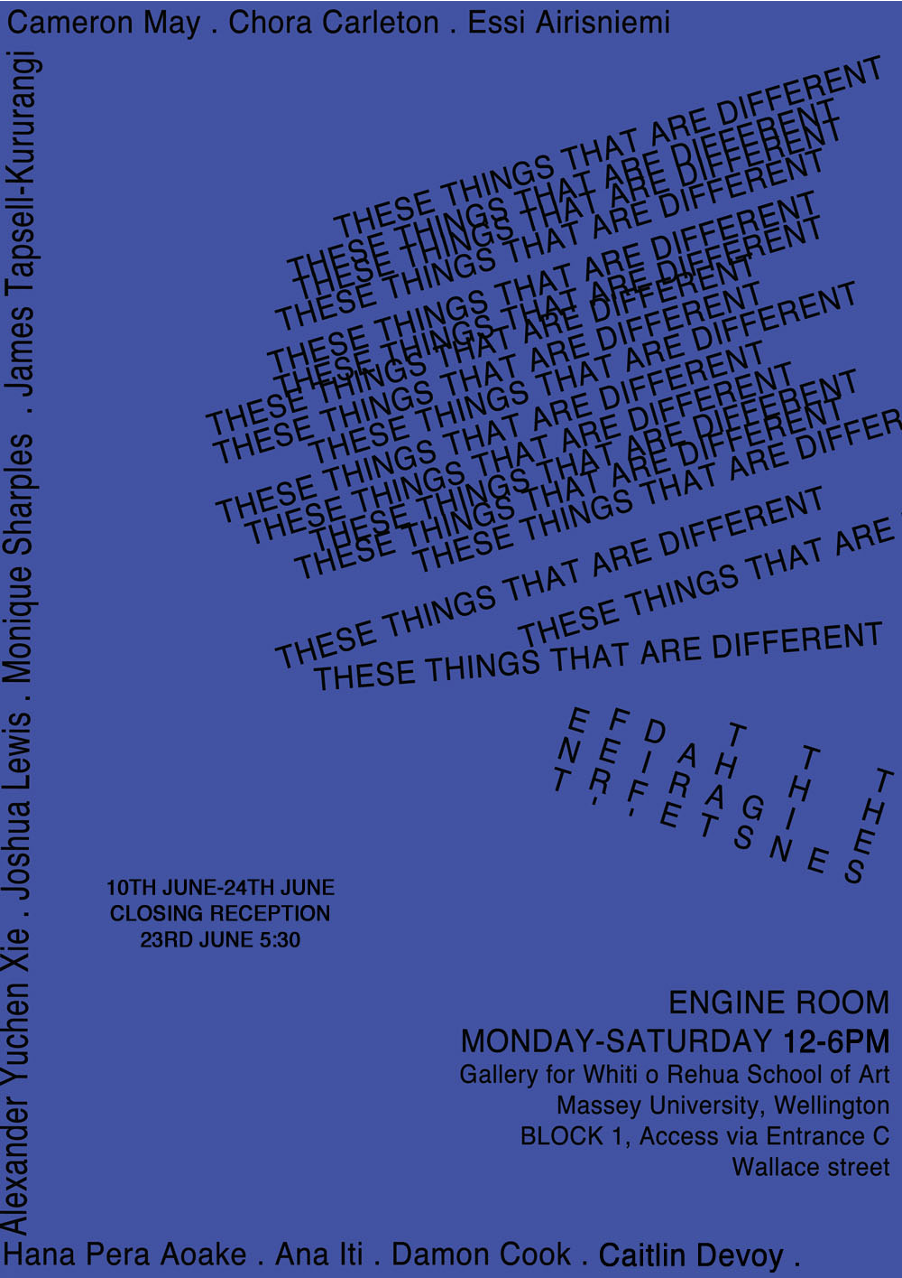
MFA Group Exhibition
10 - 24 June 2017
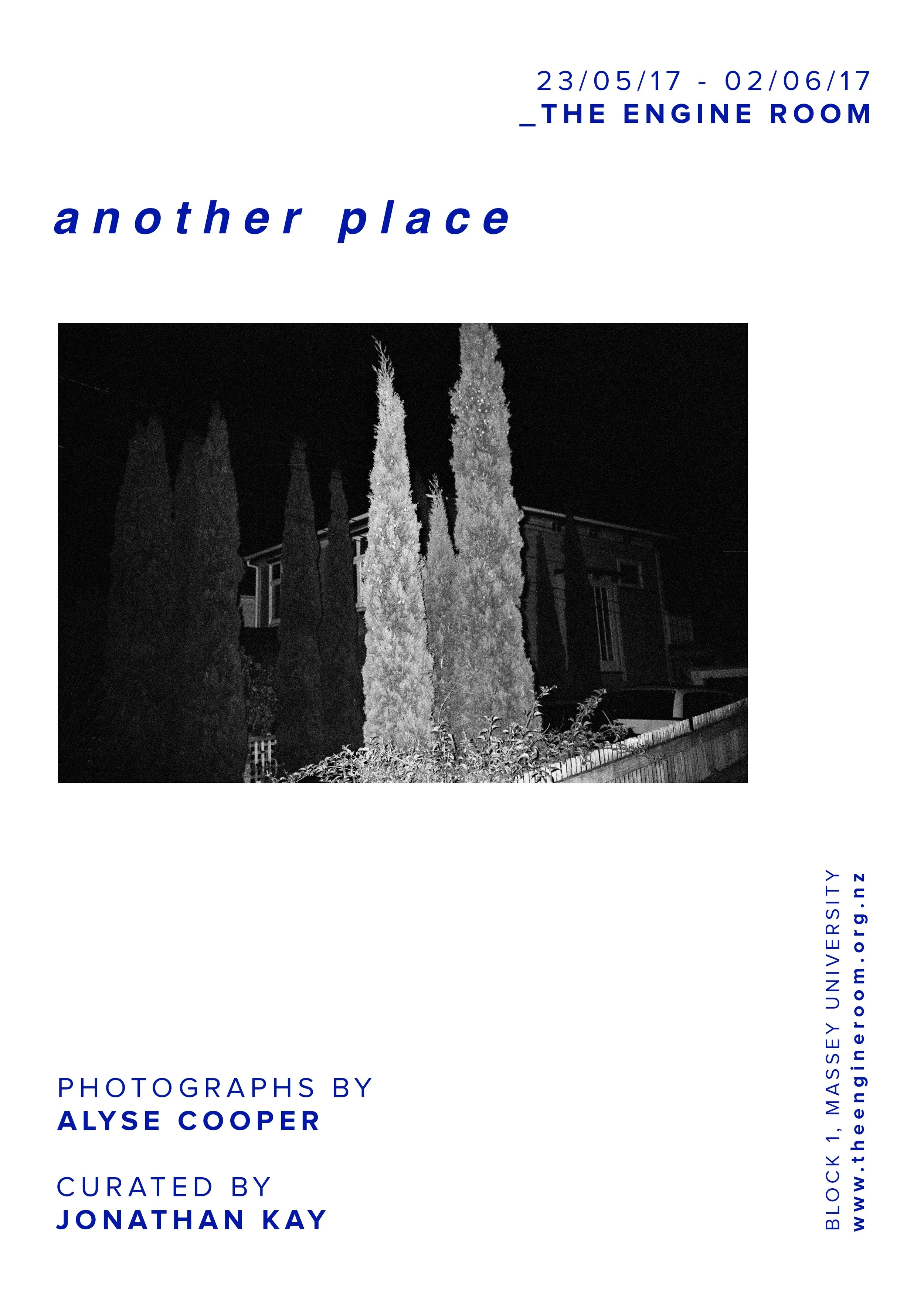
Another Place
Alyse Cooper
23 May — 2 June 2017
A Manual
The scene is set. An assessment is carried out. A frame is chosen.
Stored chemical energy remains in a suspended state connected to a family of circuits. Calculations of time and space are thought through in accordance with available light. A finger hovers as tension builds. A moment is decided. Connection: simultaneously the keeper of time opens while a reaction occurs. A discharge of electrical energy: electrons are released to the negative terminal. Electrically charged atoms that have gained or lost move through the catalysts. Oxidation reaction occurs. The current moves with intention, reaching a chamber filled with a noble gas, odourless, colourless. Electrical force builds, breaking the atoms in a violent manner. Positive and negative are split, crashing into electrodes. A micro-bolt of lightning strikes and photons are discharged, daylight is simulated at 5000 Kelvins. Photons, massless particles, travel in wave formation (299 792 458 m/s) and connect with the surface.
The scene waits. Quiet. A blinding light renders out of the darkness and, in that moment, its existence is proven, quantified, justified, seen. A plant spills its foliage like the tentacles of an octopus. Barbed for defence, it remains defiant in this harsh rocky environment. It has a history, a lineage, it belongs to the Aloaceae family. Light is its livelihood—photons converted into chemical energy. The by-product is oxygen, the air we breathe. Can it tell the difference between the sun’s rays and artificial simulated light?
The plant climbs steadily up a rock face. Its surface rusted, worn and exposed to the elements, it is slowly breaking down. Where was it created? Was it formed from the detritus of the ocean floor, or under extreme heat and pressure deep below the crust of the earth? How many millions of years old is it? These two different forms of matter that have exceptionally different lifespans sit here together, sharing a narrative.
Darkness entirely fills the background. Photons reaching an empty space or a black surface have an untimely fate. The spectrum is either consumed in the absolute absorption of light, or travels on infinitely until an interception.
Reflections travel back in straight lines though a series of organising lenses. The window is still open and the photons reach the point of conversion. A silicon surface is broken into the smallest sensitive elements known as pixels. A photon collides with a pixel and emits a charge: photoelectrons, their nature is to read as red, green or blue. This charge travels to the converter and each pixel’s information is stored as a series of ones and zeros. A record is archived, metadata attached, and is set to be deciphered back into an assemblage. The keeper of time closes. Time and space are recorded and transferred to a two-dimensional form. A process of acceptance completes the circuit. The photographer moves on.
— Jonathan Kay
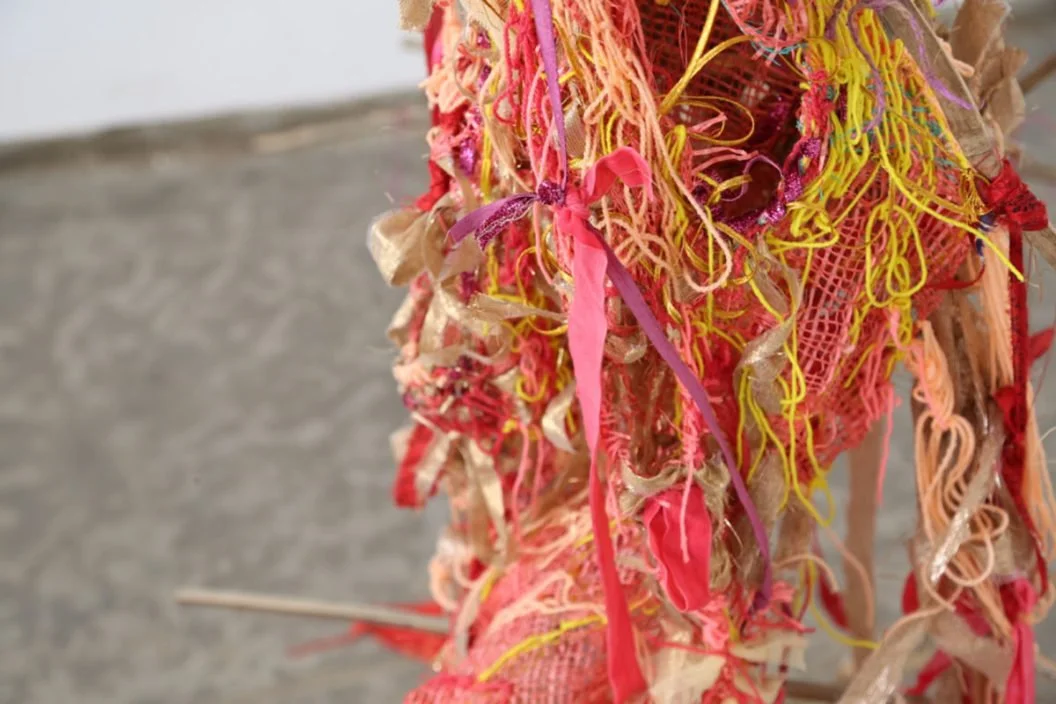
Te Aho Mano/A Thousand Strands
Sian Torrington
27 April - 13 May 2017
What if my threads are debris? What if my sacred threads are just debris? Then I am homeless. Then I am spending all my time trying to build shelters for myself. Trying to find places to put my bones. The word iwi means bones. What if I put flowers on my threads? Explosions of determined blooming are happening here. ft cannot be prevented. 1 am unable to be held down – no matter my threads unknown. No matter my unstructured pepeha. Both fragility and grit go together. These are my karanga. When 1 stand mate wahine on the paepae (on the border) 1 am an open thread to the world of te po. 1 am walking fearlessly in a place not everyone can go. I can travel to the darkness … and back. What if I cannot build? What if I cannot make myself stand? What if sticks and stones have broken my bones/my iwilk6iwi? I have cut my hair in grief. A thousand strands have fallen to the earth and from them grew all of the colours. Flight has wings. My moko kauae. Tawhirimatea is the unstoppable force of nature who cares not that you disagree, that you dislike. In the topknot. The threads I have dropped are ladders from you to me and from me to you. Hine. Mawhero came from the first woman. Her cheeks were it. Her breasts were it. Her womb sheltered it. ft is te ara, the pathway.
— Anahera Giidea
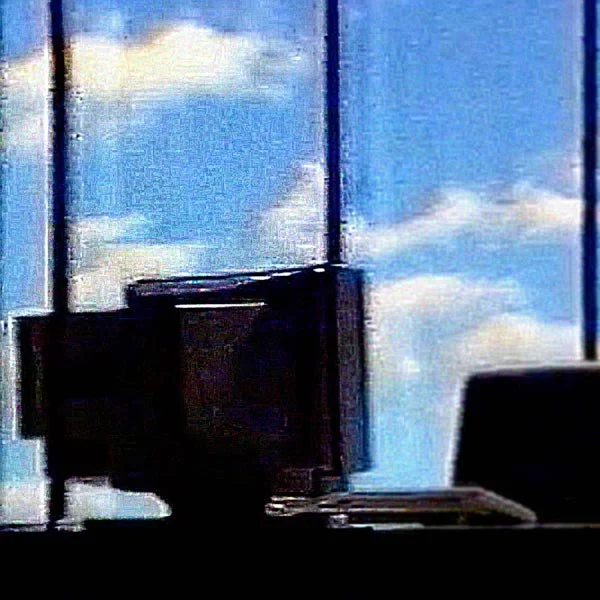
False Paths
Tim Wagg
8 - 17 March 2017
False Paths, a new installation by Tim Wagg, considers the way in which social systems have changed and shifted within New Zealand over the past 35 years.
With the election of the Labour Party in 1984, New Zealand saw radical and swift reforms to its economy. These reforms have defined how New Zealand operates up to the present day. Using the historical document TimeBomb, a 1997 documentary which argued for the disruption of the ‘Welfare State’, and a move toward a community / private provider structure of welfare within New Zealand, as it jumping off point. False Paths investigates a brief history of these changes while also exploring the desire to embrace new thinking and systems.
Tim Wagg was born in 1991 and currently lives and works in Auckland, New Zealand. Recent exhibitions include By the Laws of Chance at Dunedin Public Art Gallery (2016); transactions, frank at Blue Oyster Art Project Space (2016); New Perspectives (Produced in collaboration with Simon Denny) at ARTSPACE (2016); Let The Cobbler Stick to His Last (2015).